Published physics
Rothermel's surface spread, crown fire after Van Wagner and Cruz, embers after Sardoy and Schroeder, and a level-set fire front. A handful of its numbers are fitted to 83 California fires.
Open-source wildfire spread model
FlameLength simulates how a wildfire spreads across real terrain, hour by hour, from its fuel, the slope and the weather. On a recent graphics card, 48 hours of a large fire takes a few seconds, in your browser or on an NVIDIA GPU.
Needs WebGPU: a recent Chrome or Edge, or Safari 26 or later.
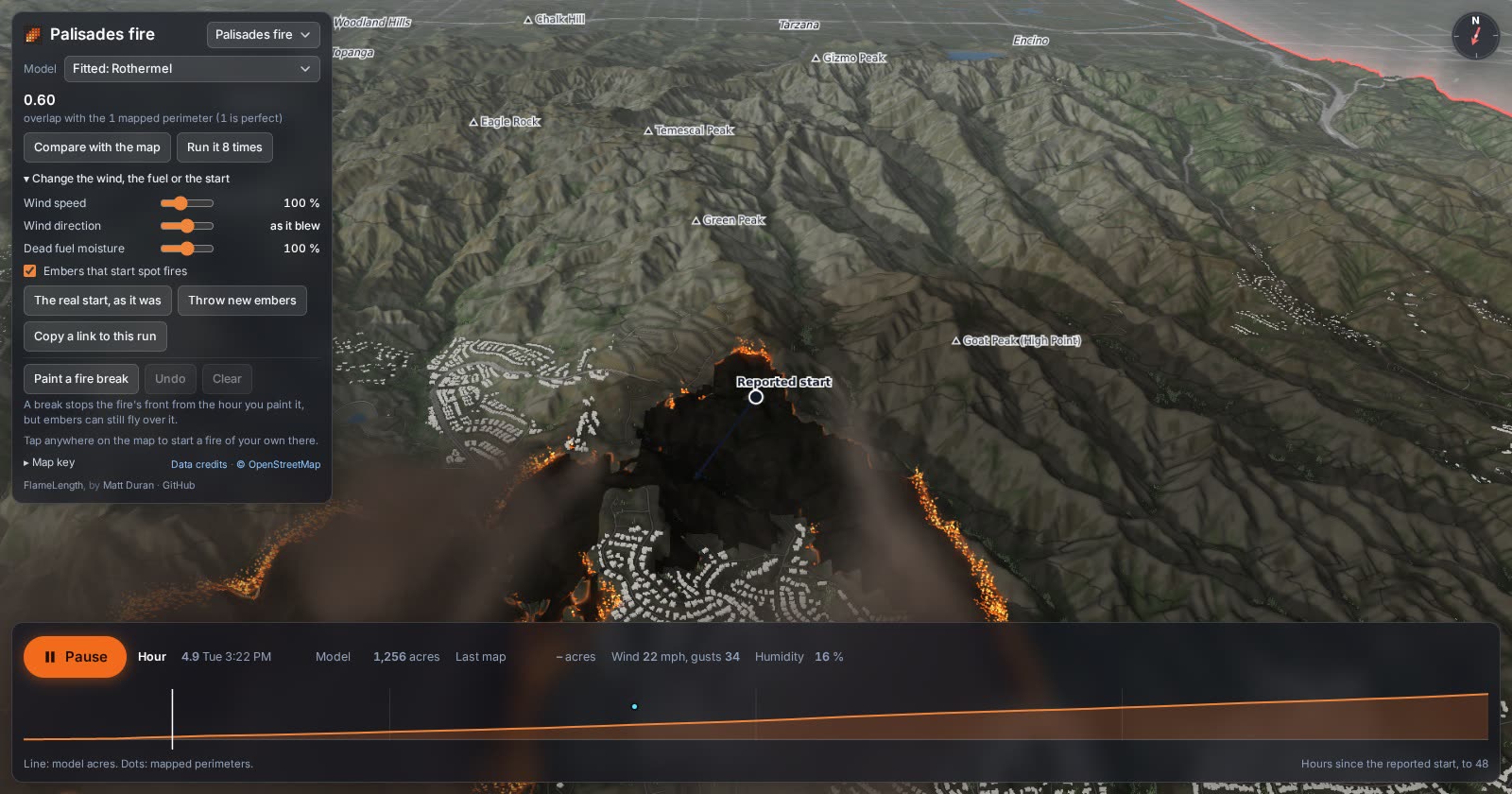
What it shows
How well it does
I score a run by how well the area it burned matches the fire's mapped perimeters, using the Sørensen overlap, where 1 is a perfect match. ELMFIRE, an established fire spread model, is the comparison.
19 Southern California fires each with its own windstorm held out of the fitting
The blind exam, 4 fires kept out of everything until the model was fixed, then opened once
| Test | FlameLength | ELMFIRE |
|---|---|---|
| 19 Southern California fires, each with its own windstorm held out of the fitting | 0.448 | 0.393 |
| The blind exam: 4 fires kept out of everything until the model was fixed, then opened once | 0.137 | 0.097 |
It failed the blind exam. To pass, it had to beat ELMFIRE on three of the four fires, and it won two. All four fires were caught within a day, and every model, mine included, ran them far too large. The 19-fire score is also short of the 0.46 I set as the bar before the first score.
How it works
Rothermel's surface spread, crown fire after Van Wagner and Cruz, embers after Sardoy and Schroeder, and a level-set fire front. A handful of its numbers are fitted to 83 California fires.
LANDFIRE fuels and canopy, NOAA's hourly HRRR weather, gridMET fuel moisture, and fire perimeters mapped by NIFC and NASA. Every source is credited, with its terms.
CUDA on NVIDIA cards, where it is fitted and scored against past fires, and a WebGPU port of the same core that runs in the demo, with the fitted settings or the published ones.
Open source
The engine, the browser port, the scorer, the fitted numbers and every test record are on GitHub.
Code and fitted numbers: MITRecords and memos: CC BY 4.0